Revisiting Brion Gysin/William Burroughs, his/their cut-up techniques and their influence on singers and artists such as Bob Dylan and Kathy Acker, and also relooking at Collage/Assemblage artists such as Robert Rauschenberg, Richard Prince etc. Thinking about how they use collage that interweaves in innovative ways, and to continue thinking and demonstrating through writing practice how this could translate into new kinds of creative narratives?
What does it mean to create Collage/Montage writing in our contemporary world?
The word collage itself is a troubling one, because there are so many different forms of collage or similar concepts/methods such as: montage, decoupage, assemblage; and words/ideas that relate to a cut-and-paste ideology, and now there is virtual collage, hypertext et cetera.
Essentially, the use of the word collage in this research specifically refers to the concept of:
‘Taking elements, be them appropriated words/images or simply influenced elements, and from these new forms of artwork, that are cut and pasted together digitally and played with (using restraints, rules etc), are created.’
Many of ideas pertaining to collage have already been exhausted and many ideas that relate to collage and collage writing are not new, therefore: This research aims to further understand/build on and add to this oeuvre, through creative writing by connecting and understanding different and often tangential (Ctrl C/Ctrl V) ways of thinking, which relate to both art and creative writing.
Appropriation
In this research, understanding the use of appropriation is important and also the exploration of how words and other people’s artworks are reused many of these notions are explored in Adaption and Appropriation by Julie Sanders. Also, key is there are lessons to be learnt here, within Kenneth Goldsmith and Kathy Acker work and methodology. The research here will look at Ideas to do intertextuality, in that that you can’t separate a single piece of text, from all the other texts that it relates to. Here to, are comparisons/similarities with Hypertextual elements used in computer programming language.
Adrian Poole has offered an extensive list of terms to represent the Victorian era’s interest in reworking the artistic past: ‘(in no particular order) … borrowing, stealing, appropriating, inheriting, assimilating … being influenced, inspired, dependent, indebted, haunted, possessed … homage, mimicry, travesty, echo, allusion, and intertextuality’ (2004: 2). We could continue the linguistic riff, adding into the mix: variation, version, interpretation, imitation, proximation, supplement, increment, improvisation, prequel, sequel, continuation, addition, paratext, hypertext, palimpsest, graft, rewriting, reworking, refashioning, re-vision, re-evaluation. Adaptation and Appropriation, Julie Sanders APPROPRIATED COLLAGE William Burroughs At a surrealist rally in the 1920s Tristan Tzara the man from nowhere proposed to create a poem on the spot by pulling words out of a hat. A riot ensued wrecked the theatre. Andre Breton expelled Tristan Tzara from the movement and grounded the cut-ups on the Freudian couch.
|
In the summer of 1959 Brion Gysin painter and writer cut newspaper articles into sections and rearranged the sections at random. Minutes to Go resulted from this initial cut-up experiment. Minutes to Go contains unedited unchanged cut ups emerging as quite coherent and meaningful prose. The cut-up method brings to writers the collage, which has been used by painters for fifty years. And used by the moving and still camera. In fact all street shots from movie or still cameras are by the unpredictable factors of passers by and juxtaposition cut-ups. And photographers will tell you that often their best shots are accidents . . . writers will tell you the same. The best writing seems to be done almost by accident but writers until the cut-up method was made explicit— all writing is in fact cut ups. I will return to this point—had no way to produce the accident of spontaneity. You can not will spontaneity. But you can introduce the unpredictable spontaneous factor with a pair of scissors. The Cut-Up Method of Brion Gysin https://ubuweb.com/papers/burroughs_gysin.html |
Kathy Acker
“ACKER: Almost all of my work is plagiarized. Very little is written by myself. It’s always other texts. Like I say, I have this theme or this problem, and what I do is take all these other texts and structure them next to each other—for various reasons. Sometimes it would be to deconstruct. Sometimes it would be to construct, sometimes to compare, sometimes to find out…”
“ACKER: Yeah. The idea that you don’t need to have a central identity, that you could have a split identity and that was a more viable way in the world. I was splitting the I into false and true I’s and I just wanted to see if this false I was more or less real than the true I, what are the reality levels between false and true and how it worked. And of course there’s no difference. By the end of the Tarantula, when I do the de Sade business, I can’t tell what’s true or false. And the only reason I can tell there’s the truth is that I’m remembering the fact. I took a biography of de Sade and placed it next to my own biography, and except for actual dates that I remember—if I say I was born in 1848 I know that’s false—I can’t tell what’s me and what’s de Sade.”
“ACKER: You know, what a writer does, in nineteenth-century terms, is that he takes a certain amount of experience—you don’t just make things up, be it a story, or an autobiographical material, or be it social history, whatever—and he “represents” that material. Now what I’m doing is simply taking text to be the same as else’s text—well, that’s the etymology! Hijacking a copyright, so to speak. No wonder they got upset. It’s terrorism in literature…”
“ACKER: I can’t remember who or what I saw and who I was influenced by until it comes to the Metro Pictures times. Then I know like Richard Prince’s work and Sherrie Levine’s work and David Salle’s work really influenced me.”
Kathy Acker:
The last interview and other stories
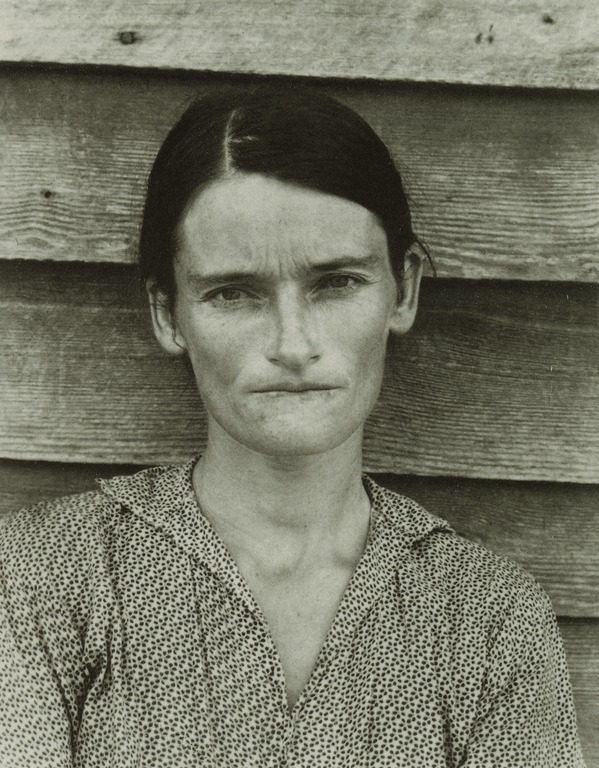
SHERIE LEVINE
Sherrie Levine, Barcham Green Portfolio No. 5. After A Photograph, 1986
Fountain (After Marcel Duchamp), Cast bronze and artist’s wooden base, 1991 |
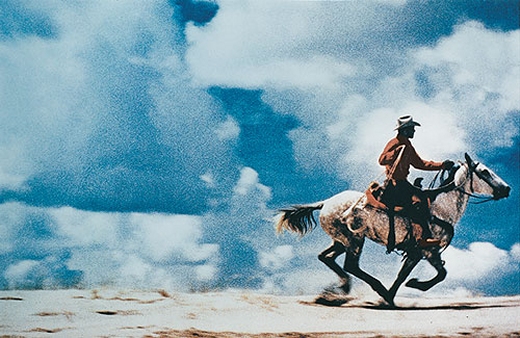
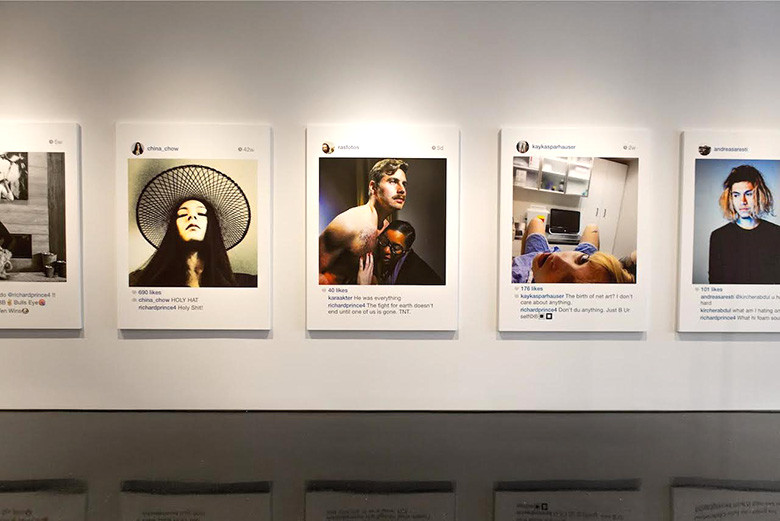
RICHARD PRINCE
Richard Prince, "Untitled (Cowboy)," 1989. Ektacolor photograph. 50 x 70 inches.
|
, 1991 Cast bronze and artist’s wooden base.jpg)
???
??? |
??? |
???
???